Posted on: 31 July 2026
Choosing industrial land in Angola is one of the most important decisions an investor will make. While land price is often the first consideration, long-term project success depends on much more than the cost per square metre. Infrastructure, utilities, logistics, legal certainty and future expansion capacity all influence whether an industrial project can operate efficiently and remain competitive.
These factors are increasingly recognised as key drivers of Foreign Direct Investment (FDI) decisions, particularly in emerging markets, according to analysis by UNCTAD
This guide explains the key factors businesses should evaluate before selecting industrial land in Angola, why industrial parks often reduce development risk and how integrated developments such as Dubai Investments Park Angola (DIP Angola) support industrial investment.
For many investors, purchasing industrial land is viewed as a real estate transaction. In reality, it is an operational decision that will affect construction costs, production efficiency, logistics performance and future business growth for years to come. A lower land price may appear attractive at first, but if the site lacks reliable infrastructure, transport connections or access to utilities, the total investment required can increase significantly.
Successful industrial projects begin by asking a different question: Can this location support my business efficiently over the next 10 to 20 years? That question shifts the focus from acquisition cost to long-term operational performance.
This long-term perspective aligns with Angola's industrialisation strategy, which prioritises productive investment, industrial diversification and manufacturing growth. More information is available from the Ministry of Industry and Commerce.
Selecting industrial land should be part of a broader investment assessment rather than the first step in a project. Before comparing locations, businesses should clearly understand:
Once these operational needs have been defined, investors can evaluate whether a specific site is capable of supporting them.
Infrastructure is often the single most important factor in determining whether an industrial development remains on schedule and within budget. Before acquiring industrial land, investors should verify the availability and capacity of:
The question is not simply whether these services are available, but whether they can support the scale of the planned operation, both now and as the business expands.
Industrial facilities depend on efficient logistics. Raw materials must arrive reliably, while finished products need to reach customers without unnecessary delays or additional costs. When evaluating industrial land in Angola, businesses should consider:
Angola has invested in improving transport corridors, logistics infrastructure and regional connectivity as part of its long-term economic development strategy. Projects supported by institutions such as the African Development Bank continue to strengthen the country's transport network. A strategically located industrial site can improve supply chain performance for decades, while a poorly connected location may create permanent operational constraints.
Industrial operations rely on consistent access to electricity and water. Interruptions or insufficient capacity can affect productivity, increase operating costs, and limit future expansion. Rather than simply confirming that utilities are available, investors should assess:
Understanding these factors early can reduce the risk of unexpected infrastructure costs after construction begins.
Industrial land should also be assessed from a legal and regulatory perspective. Before committing to a site, investors should confirm:
Carrying out legal and technical due diligence before acquisition helps reduce project risk and provides greater certainty during development. Investors should also familiarise themselves with Angola's investment framework and establishment procedures.The AIPEX (Agency for Private Investment and Export Promotion) provides guidance for foreign investors on investment legislation, incentives and business establishment.
One of the most important decisions investors face is whether to develop on an isolated industrial plot or within a planned industrial park. Standalone sites can offer flexibility, but they often require businesses to coordinate infrastructure, utilities, security and maintenance independently. Industrial parks are designed to reduce this complexity.
By bringing together transport infrastructure, utilities, technical services and space for expansion within a single planned environment, industrial parks allow businesses to focus on their operations rather than basic site development. For many investors, this translates into:
Rather than eliminating investment risk, industrial parks help reduce the operational uncertainty associated with establishing a new industrial facility.
Choosing industrial land is ultimately about selecting an environment where a business can establish operations efficiently and continue to grow. Dubai Investments Park Angola (DIP Angola) has been planned with this objective in mind.
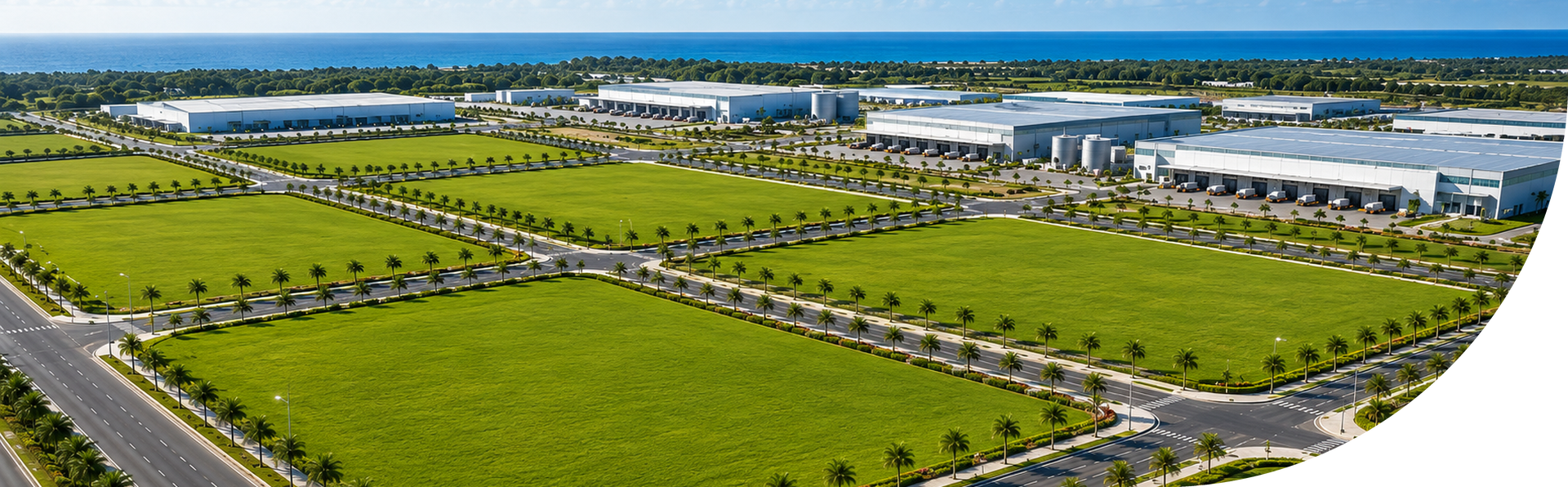
Located in Barra do Dande, approximately 50 kilometres from Luanda, the development combines industrial, logistics, commercial and residential areas within a single master-planned ecosystem. Its design aims to provide businesses with access to infrastructure, utilities and strategic transport connections while allowing room for future expansion. For companies evaluating industrial land in Angola, developments such as DIP Angola demonstrate how integrated planning can simplify site selection and reduce the operational complexity associated with new industrial projects.
Choosing industrial land in Angola is not simply about finding available space. It is about selecting a location capable of supporting efficient operations, sustainable growth and long-term competitiveness. By evaluating infrastructure, logistics, utilities and legal considerations before acquiring a site, investors can reduce project risk and make more informed decisions.
For businesses exploring industrial investment opportunities in Angola, integrated developments such as Dubai Investments Park Angola offer an environment designed to support industrial operations from establishment through long-term expansion.

You can download our brochure for more information about the project Download