Posted on: 29 July 2026
Investing in Angola offers significant opportunities across manufacturing, logistics, agriculture and industrial development. As one of Africa's largest economies, Angola is pursuing economic diversification while investing in infrastructure designed to support private investment. However, market potential alone is not enough to guarantee success.
Companies considering investing in Angola should assess market demand, the legal framework, foreign exchange exposure, infrastructure, logistics and site selection before committing capital. This guide explains the key factors investors should evaluate, highlights sectors with strong growth potential and outlines how industrial developments such as Dubai Investments Park Angola (DIP Angola) can support long-term business operations.
For many international companies, Angola represents one of Africa's most promising long-term investment destinations. With abundant natural resources, a growing population and a strategic location on the Atlantic coast, the country offers opportunities across multiple industries beyond oil and gas.
Yet successful investment decisions are rarely driven by market size alone. The strongest business case for investing in Angola lies in the gap between existing market demand and the country's capacity to manufacture, process, store and distribute goods locally. Closing these gaps creates opportunities for companies that can combine technical expertise, patient capital, and operational know-how with a long-term investment strategy.
According to the World Bank's Angola Economic Update (July 2025), Angola's economy grew by 4.4% in 2024, supported not only by the oil sector but also by stronger performance in mining, agriculture and trade. While the country continues to recover from the economic contraction experienced between 2016 and 2020, the report also highlights the increasing importance of economic diversification as a driver of future growth. This transition creates opportunities for businesses to contribute to domestic production, improve supply chains, and reduce dependence on imported goods.
However, investors should distinguish between market potential and operational feasibility. Identifying demand is only the first step. Long-term success depends on understanding regulation, infrastructure, logistics, access to utilities, workforce availability and the total cost of operating within the Angolan market.
No single industry can be described as the "best" sector for investing in Angola. Opportunities vary according to market demand, operational complexity and the competitive landscape. Instead of following global investment trends, businesses should evaluate where supply gaps exist and whether they have the expertise to address them profitably.
The Private Investment Act sets out the principles, guarantees, rights, duties, benefits and facilities applicable to private investment in Angola. The regime currently in force stems from Act No. 10/18 of 26 June, as amended and republished by Act No. 10/21 of 22 April.
AIPEX is responsible for promoting, registering and monitoring private investment and provides institutional and legislative information. Nevertheless, consulting public information is no substitute for up-to-date legal, tax, foreign exchange and sector-specific advice, particularly from the relevant government ministry.
Manufacturing remains one of the country's strongest investment opportunities. Demand for locally produced food products, beverages, packaging, construction materials, consumer goods and industrial inputs continues to grow as Angola seeks to strengthen domestic production and reduce reliance on imports. Local manufacturing can shorten supply chains, improve product availability and reduce transport costs. Nevertheless, competitiveness depends on much more than replacing imported goods. Successful manufacturers must also secure reliable access to energy, raw materials, skilled labour, maintenance services and efficient distribution networks. Production costs, quality standards and economies of scale ultimately determine whether a manufacturing investment becomes commercially sustainable.
Agriculture offers considerable potential, but much of the value lies beyond primary production. Food processing, cold storage, packaging, logistics and distribution often create greater commercial opportunities than agricultural production alone. Angola's favourable climate and extensive agricultural land provide strong foundations for agribusiness. However, investors should assess the complete value chain, including water availability, productivity, transport infrastructure, storage capacity and access to consumer markets. A processing facility without consistent access to raw materials—or without efficient routes to market—may struggle regardless of production capacity.
As Angola's industrial base expands, demand for logistics services continues to increase. Warehousing, freight transport, distribution centres and supply chain management all play an essential role in supporting economic growth. Location alone, however, does not guarantee operational efficiency. Investors should evaluate road quality, access to ports, customs procedures, storage capacity, cargo security and transit times. These factors directly influence operating costs and customer service levels. Companies planning regional operations should also consider how their facilities connect with existing and future transport corridors.
Industrial growth creates demand far beyond manufacturing itself. Every new factory, warehouse or commercial facility requires reliable energy, digital connectivity, maintenance services, cybersecurity, financial services and skilled technical support. These sectors present attractive opportunities for companies capable of delivering specialised business services that strengthen Angola's broader industrial ecosystem. Success depends not only on technology, but also on local expertise, customer relationships and the ability to provide ongoing support within the country.
Every investment opportunity involves risk. Understanding those risks before entering the market allows companies to make informed decisions and develop realistic financial models. Businesses considering investing in Angola should assess several critical factors before committing capital:
These considerations should shape an investment strategy from the outset rather than being treated as secondary risks after a project has been approved.
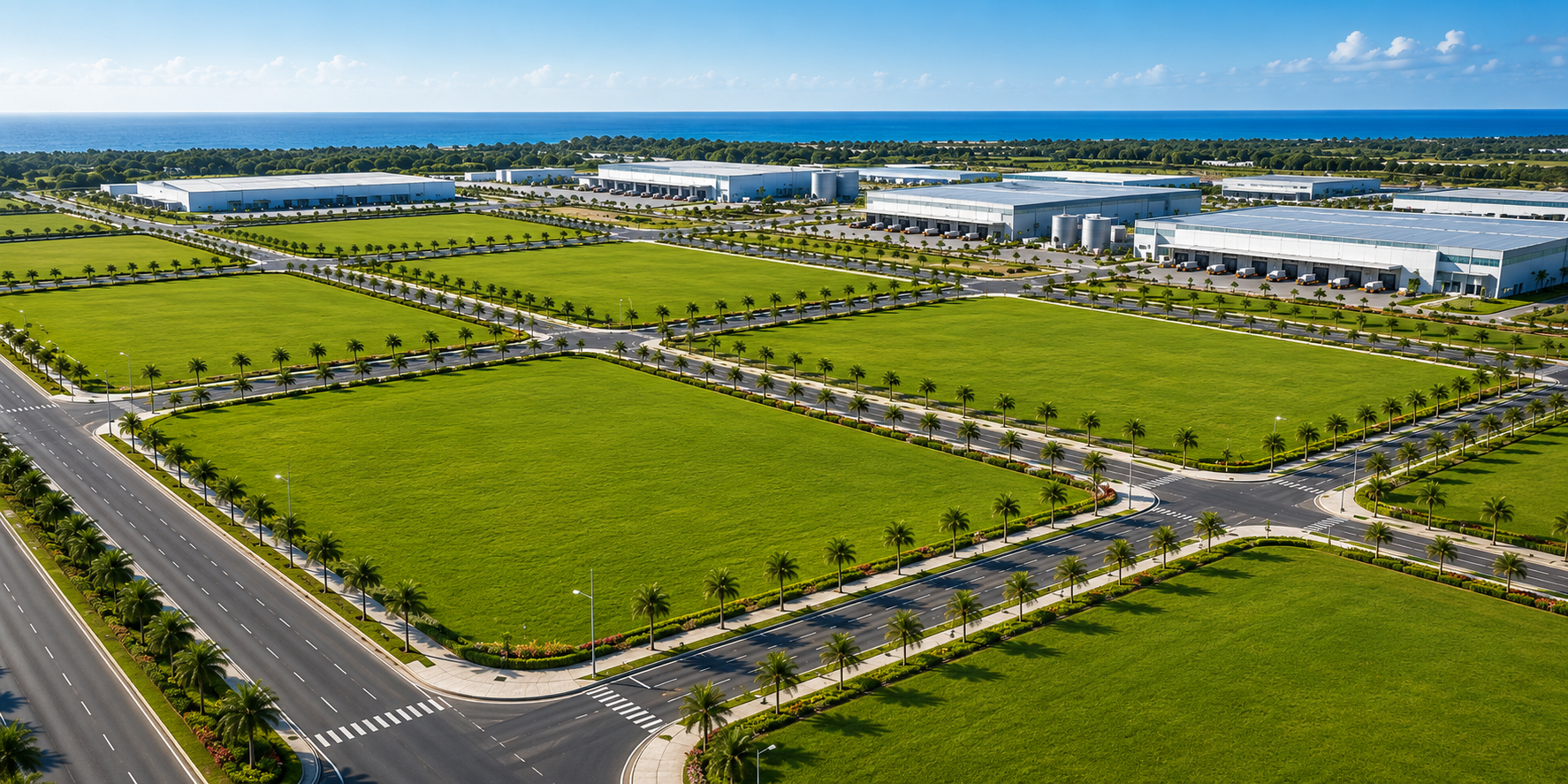
DIP Angola is an integrated 2,000-hectare development located in Barra do Dande, Bengo, approximately 50 kilometres from Luanda. The DIP Angola corporate brochure showcases industrial, commercial and residential zones, public facilities, hotels, leisure amenities and green spaces, all of which are clearly defined and designed in a coherent, integrated and functional manner. The scale of the project allows for the integration of economic activity, services and living conditions within the same area. This is the true mixed-use concept.
The first phase covers 400 hectares. The infrastructure for this phase was completed and operational, including paved internal roads, drainage, water, energy, telecommunications and ICT networks, as well as industrial plots prepared for construction. The development is planned in phases over approximately 12 years. It is therefore important to distinguish between what is already available and what belongs to later stages.
The location provides a road link to the EN-100 and includes primary, secondary and local internal access routes. The institutional documentation also provides for a future rail link coordinated with the Dande municipal plan. This should be presented as planned infrastructure, not as a currently operational link.
The available data allow for an explanation of the scale, location and general status of the first phase. For an investment assessment, specific operational and commercial details are still required. The DIP Angola should not be presented as a one-size-fits-all solution for any investor. Its relevance depends on the alignment between the planned operation and the technical, logistical, commercial and expansion conditions actually available.

You can download our brochure for more information about the project Download