Posted on: 23 Sep 2026
Setting up a manufacturing company in Angola involves more than registering a business and finding industrial land. Before committing capital, investors need to validate demand, determine the appropriate investment and corporate structure, understand sector-specific requirements, and ensure that the chosen location can support production.
Angola's efforts to increase domestic production and diversify its economy are creating opportunities for manufacturers. However, the viability of each project depends on its own economics, supply chain, infrastructure requirements, and ability to operate competitively within the local market. This guide outlines the main areas investors should evaluate when planning a manufacturing operation in Angola and explains why decisions about market entry, licensing, infrastructure, and location should be considered together.
The first step should not be registering a company or selecting a plot. It should be determining whether the proposed manufacturing operation has a viable market. Before establishing a factory, investors should understand:
This analysis determines the scale and structure of the investment that follows. A product that is currently imported into Angola may indicate an opportunity for local production, but import demand alone does not prove that manufacturing locally will be competitive.
Manufacturing investments fall within Angola's wider private investment framework. The Private Investment Act establishes the principles, guarantees, rights, duties, benefits and facilities applicable to private investment in the country. The current framework derives from Act No. 10/18 of 26 June, as amended and republished by Act No. 10/21 of 22 April. The legislation applies to domestic and foreign private investments, while certain industries may also be subject to specific sector regulation.
AIPEX, Angola's Private Investment and Export Promotion Agency, performs functions related to the promotion, registration and monitoring of private investment. Investors should determine the investment regime, corporate structure, registrations and approvals applicable to their particular project before establishing operations. Legal, tax and regulatory requirements should always be verified for the individual investment rather than assumed solely from the type or value of the project.
There is no single licensing process that applies identically to every factory. Requirements depend on what the company will manufacture, the production process, and the regulations applicable to that sector. A food-processing facility, for example, may face different technical and regulatory requirements from a construction-materials manufacturer or industrial assembly operation. Investors should therefore identify early:
Understanding these requirements before construction can help prevent delays between completing a facility and beginning commercial production.
Once the business model and technical requirements are clear, investors can begin comparing industrial locations. The cheapest industrial plot is not necessarily the location with the lowest overall cost. Manufacturers should assess whether a site provides appropriate access to:
Manufacturing requires both inbound and outbound logistics. Machinery, raw materials and components must reach the factory, while finished products must move efficiently towards warehouses, distributors or final customers. For companies dependent on imported inputs, port connectivity and road transport can have a direct impact on production costs, inventory levels and working capital.
Investors should therefore calculate logistics requirements before choosing a factory location. Important considerations include transport times, freight costs, storage requirements, import dependency and proximity to the principal customer base. Logistics should form part of the factory's financial model rather than being treated as a secondary consideration after the site has been selected.
For some manufacturers, establishing within a planned industrial park can reduce the complexity associated with developing an isolated industrial site. Industrial parks may bring together land, roads, utilities, telecommunications, and other supporting infrastructure within an environment designed for industrial operations. However, investors should not assume that every industrial park can support every type of manufacturing. Before selecting a development, businesses should verify:
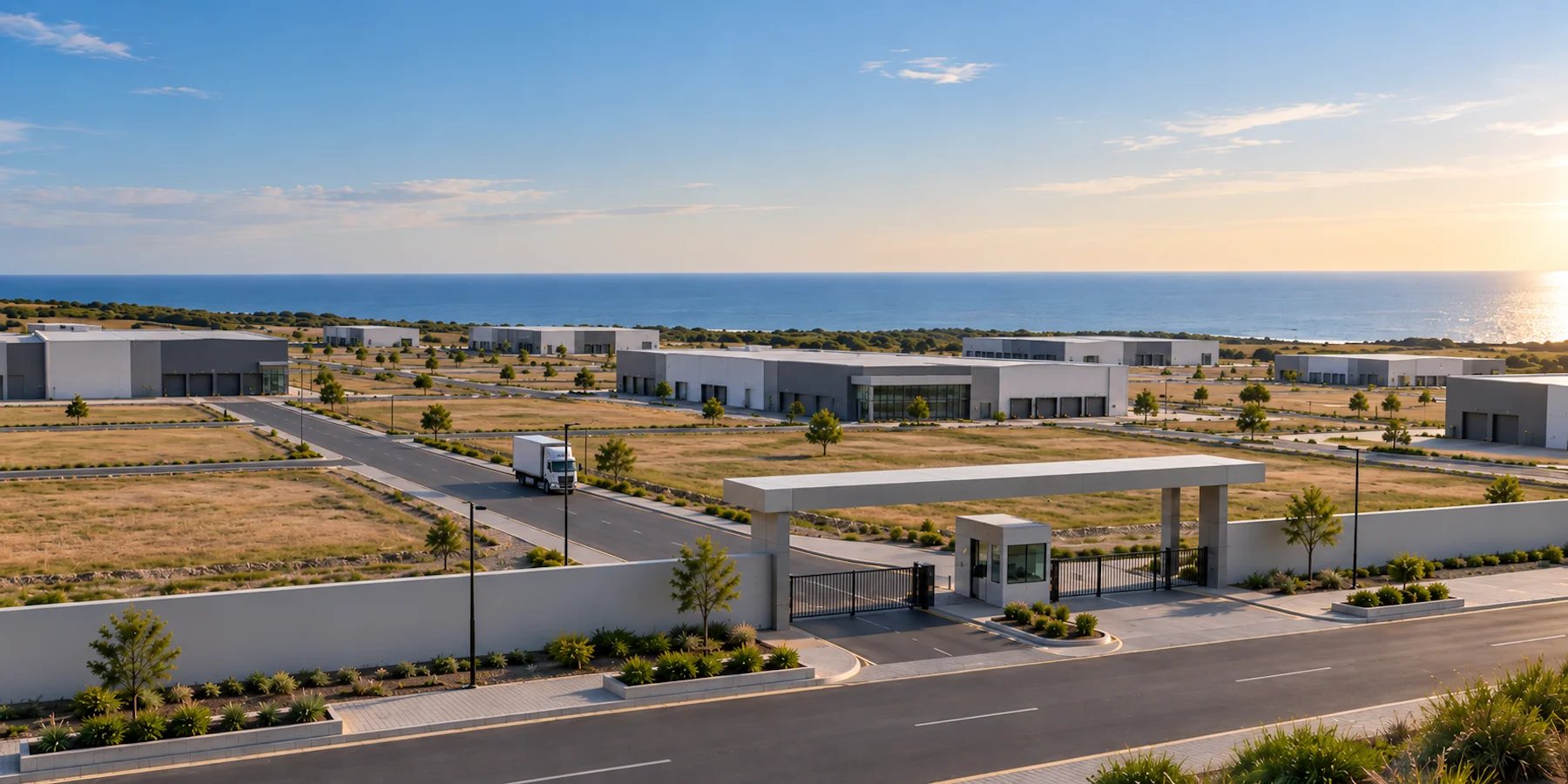
Dubai Investments Park Angola (DIP Angola) is a 2,000-hectare integrated development located in Barra do Dande, Bengo Province, approximately 50 kilometres from Luanda. The development combines industrial, logistics, commercial and residential areas within a master-planned environment.
Its first phase covers approximately 400 hectares and includes paved internal roads, drainage, water, energy, telecommunications and ICT networks, together with industrial plots prepared for development. The location also provides connectivity to the EN-100.
For manufacturers looking for industrial land in Angola, DIP Angola can support the process from identifying a suitable plot through to planning for development. Industrial land is organised within designated zones, allowing plots to be considered according to the proposed activity, required permits, plot size, utility requirements, logistics access and potential for future expansion.
The DIP Angola team has practical experience supporting businesses that have already secured industrial plots and are progressing towards the construction of their facilities. This growing on-the-ground knowledge, combined with planned infrastructure, industrial zoning, and access to larger plots, can help manufacturers evaluate and establish operations within an environment specifically planned for industrial growth in Angola.
Planning a manufacturing operation in Angola? Request current information from the DIP Angola team on industrial plots, infrastructure, connectivity, and development conditions.

You can download our brochure for more information about the project Download