Posted on: 15 Sep 2026
Industrial parks can simplify one of the most complex decisions facing manufacturers and industrial investors: where and how to establish an operation. Rather than developing an isolated site and coordinating infrastructure, utilities, access, security, and other services independently, an industrial park can bring several of these requirements together within a planned environment.
However, being classified as an industrial park does not automatically make a location suitable for every investor. Infrastructure capacity, logistics, permitted activities, operating costs, expansion potential, and the actual readiness of the site must all be assessed before committing capital. This guide explains what investors should look for when evaluating industrial parks in Angola and how to determine whether a development can support a business over the long term.
As Angola seeks to diversify its economy and increase domestic production, industrial development requires more than investment in factories. Businesses also need land, roads, electricity, water, telecommunications, logistics infrastructure, and access to workers, suppliers, and customers.
When these requirements have to be developed independently, establishing an industrial operation can become more expensive and complex. Industrial parks can address part of this challenge by concentrating industrial land and supporting infrastructure within a defined development. For investors, the potential advantage is therefore not simply access to land. It is the possibility of establishing operations within an environment already planned for industrial activity.
Comparing industrial parks should begin with the requirements of the business rather than the characteristics advertised by each development. A food-processing facility, logistics warehouse, and heavy manufacturing plant will have very different requirements.
An industrial park does not operate in isolation. Raw materials must reach factories, finished products must reach customers, and employees must be able to access the site. A location that appears further from a market may still be operationally competitive if transport routes are efficient and predictable.
When comparing industrial parks in Angola, businesses should evaluate:
Land price is only one component of industrial location cost. A lower-cost plot can become considerably more expensive if an investor must independently finance utility connections, access roads, drainage, security, or other infrastructure.
The more relevant calculation is the total cost of establishing and operating the business at that location. This allows industrial parks to be compared according to their impact on the complete business model rather than price per square metre alone.
Investors should therefore examine:
Industrial investment is normally a long-term decision. A company may initially require one production facility or warehouse but need significantly more capacity five or ten years later. Expansion potential should therefore be considered before selecting the initial plot.
Investors should understand whether additional land may be available, whether utility networks can support greater demand, and whether the wider development is designed to accommodate future industrial growth. A site that works for the first phase but prevents future expansion can create substantial relocation or infrastructure costs later.
Not every industrial park is suitable for every type of industry. Land-use planning, environmental requirements and technical infrastructure can determine which manufacturing, processing, warehousing or logistics activities can operate within a particular development.
Before committing to a site, investors should confirm that their planned activity is permitted and determine what approvals or sector-specific licences may be required. This assessment should form part of the wider legal and technical due diligence carried out before establishing an industrial operation in Angola.
Not necessarily. Standalone industrial sites can offer flexibility and may be appropriate for businesses with specific land, infrastructure or location requirements. However, they can also require investors to coordinate more elements independently.
Industrial parks may reduce this complexity by providing a planned environment where land, infrastructure and supporting services are considered together. The relevant question is therefore not whether an industrial park is always better.
It is: Which location allows the business to establish, operate and expand with the most appropriate combination of cost, infrastructure and operational certainty? The answer will depend on the individual investment.
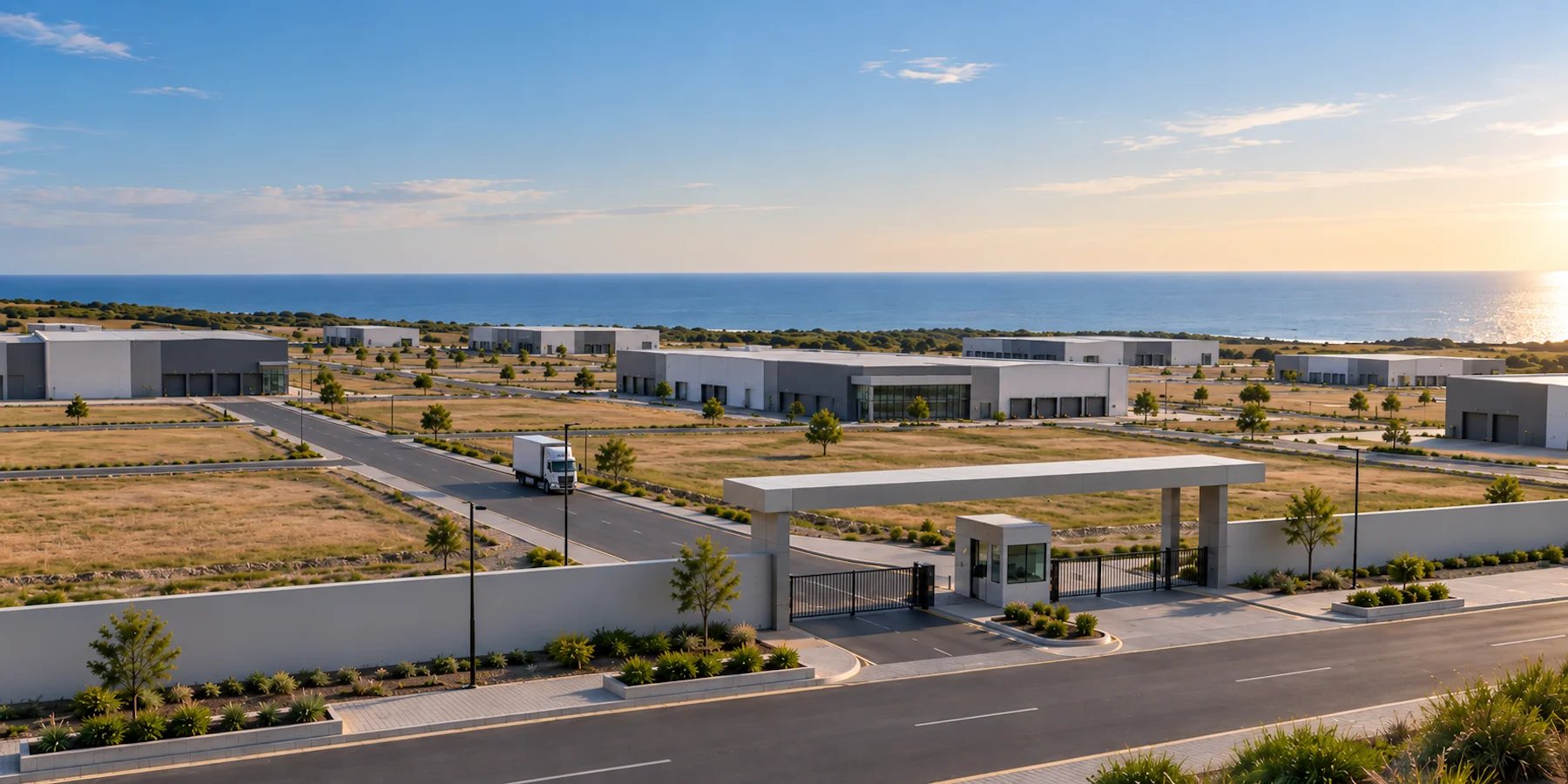
Dubai Investments Park Angola (DIP Angola) is a 2,000-hectare integrated development located in Barra do Dande, Bengo Province, approximately 50 kilometres from Luanda. The development combines industrial, logistics, commercial and residential areas within a master-planned environment.
Its first phase covers approximately 400 hectares. Infrastructure within this phase includes paved internal roads, drainage, water, energy, telecommunications and ICT networks, together with industrial plots prepared for development. The location also provides road connectivity to the EN-100, while the wider Barra do Dande area includes existing and planned logistics infrastructure.
For an industrial investor, the relevance of DIP Angola should therefore be evaluated in the same way as any other industrial location: by determining whether its land, infrastructure, connectivity, costs, and expansion potential correspond to the requirements of the planned operation.
An integrated industrial development can reduce certain aspects of establishment complexity, but the final investment decision must remain specific to the business.
Evaluating industrial land or an industrial park in Angola? Request current information from the DIP Angola team on available plots, infrastructure, connectivity, and development conditions.

You can download our brochure for more information about the project Download